Filmed in the first half of 1998, released in 1999, The Matrix is now 25 years old. The movie that was once considered the exemplar of avant-garde pop cinema has become déclassé. In his Variety review of The Matrix Resurrections (21 December 2021), Peter Debruge observed, “a property that was once so appealing for being cutting-edge is now being mined for its nostalgia value.” Clearly, in the pop cinema world, a quarter of a century is a long time: heavy-handed symbols such as red pills, blue pills, and disposable batteries have aged as poorly as non-fungible tokens. Few of those born after 1999 understand what a phone booth was for, the purpose or function of a (telephone) “operator,” or why this “operator” has to search for an available telephone in order to enable a character’s “exit” from the matrix (or “insertion” for that matter). The dial-up internet access that informed The Matrix is now as antiquated as a 1960s telephone switchboard. The green numerals of the opening credits, inspired by archaic CRT computer monitors, now appear self-consciously arty, and the greenish hue that influenced the color scheme of the film now seems quaint and affected. The virtual reality plot can now be seen for what it is, a variation of the time-travel plot, or asynchronous parallelism—co-existing parallel worlds on different time tracks—one time track being “subjective” reality, the other “objective.” The cumbersome dial-up access to the matrix occasionally gave rise to narrative implausibility, for instance, the betrayal scene, in which Cypher secretly meets with Agent Smith: how is Cypher able to insert himself into the matrix without the aid of an operator, and subsequently extract himself from the matrix without an operator’s assistance? However, given that its plot shifts are as abrupt as someone cutting the hard line, and given that its visual stylizations (e.g., "bullet time") take precedence over narrative coherence, one lasting achievement of The Matrix has made asking such questions seem improper.
Sunday, September 24, 2023
The Matrix at 25
Filmed in the first half of 1998, released in 1999, The Matrix is now 25 years old. The movie that was once considered the exemplar of avant-garde pop cinema has become déclassé. In his Variety review of The Matrix Resurrections (21 December 2021), Peter Debruge observed, “a property that was once so appealing for being cutting-edge is now being mined for its nostalgia value.” Clearly, in the pop cinema world, a quarter of a century is a long time: heavy-handed symbols such as red pills, blue pills, and disposable batteries have aged as poorly as non-fungible tokens. Few of those born after 1999 understand what a phone booth was for, the purpose or function of a (telephone) “operator,” or why this “operator” has to search for an available telephone in order to enable a character’s “exit” from the matrix (or “insertion” for that matter). The dial-up internet access that informed The Matrix is now as antiquated as a 1960s telephone switchboard. The green numerals of the opening credits, inspired by archaic CRT computer monitors, now appear self-consciously arty, and the greenish hue that influenced the color scheme of the film now seems quaint and affected. The virtual reality plot can now be seen for what it is, a variation of the time-travel plot, or asynchronous parallelism—co-existing parallel worlds on different time tracks—one time track being “subjective” reality, the other “objective.” The cumbersome dial-up access to the matrix occasionally gave rise to narrative implausibility, for instance, the betrayal scene, in which Cypher secretly meets with Agent Smith: how is Cypher able to insert himself into the matrix without the aid of an operator, and subsequently extract himself from the matrix without an operator’s assistance? However, given that its plot shifts are as abrupt as someone cutting the hard line, and given that its visual stylizations (e.g., "bullet time") take precedence over narrative coherence, one lasting achievement of The Matrix has made asking such questions seem improper.
Thursday, September 21, 2023
A Rock 'n' Roll Fantasy (Conclusion)
After roughly a decade, Angelique Pettyjohn resumed her career as a supporting actress in the movies. In 1979, for instance, she appeared as an extra in the comedy, Going in Style, but by then she was better known as a Las Vegas showgirl. In the mid-1970s, she had been a featured showgirl in the Vive Paris Vive show at the Aladdin Hotel, and by 1978 had teamed with comedian Bob Mitchell in an “Olde Tyme Burlesque” show at the Maxim Hotel & Casino which, at the time, was the only fully nude strip club in Las Vegas. (The advertisement is taken from the Vegas Visitor paper, October 5-11, 1979.) She was photographed by Robert Scott Hooper for the February 1979 Playboy pictorial, “The Girls of Las Vegas,” and beginning in the early 1980s, she began to make appearances at Star Trek conventions, appearing in her Shahna costume from “The Gamesters of Triskelion,” selling signed pictures for fans. She also appeared in several movies in the 1980s, and also married for the fifth time (not fourth), a marriage that also ended in divorce (1984-1989). Dr. Flynn met her on the Star Trek convention circuit in the early 1980s and became a friend of hers, remaining so until her death on February 14, 1992, at age 48. It was his friendship with her that prompted him to write the book, The Sci-Fi Siren Who Dared Love Elvis and Other Stars, although by the time of the book's publication, in 2020, the subject of his book had been dead 28 years.
Despite the argument put forth in Dr. Flynn’s book, there is no factual evidence that Elvis Presley was in Las Vegas in March 1961. There is not one shred of factual evidence in Dr. Flynn's book proving without doubt that Dorothy Perrins was in Las Vegas in March 1961, either. In 1967, she did indeed appear in Clambake with Elvis Presley, that is factually true. And she may indeed be the mother of the man who now calls himself Elvis Aaron Presley, Jr. About that matter, I can say nothing. For additional information about Elvis's activities in 1961, there is a several hundred-page, exhaustively detailed book by Peter Guralnick and Ernst Jorgensen, titled Elvis Day By Day (Ballantine, 1999), that provides additional evidence to support my claims. Ironically, Elvis's one child, Lisa Marie Presley (1968-2023) is now deceased, but the "zombie lie" of Elvis's supposed love children lives on.
Monday, September 18, 2023
A Rock 'n' Roll Fantasy, Pt. 3
Unmentioned in any account of her life that I have come across, Angelique Pettyjohn had been married and divorced before she married Otho A. Pettyjohn, Jr. in May 1966. Her first marriage was to William Krebs (NOT his actual name; I am withholding his name out of respect for his privacy), which took place on April 6, 1963, in Elko, Nevada. Both of them were 20 years old. Did the couple impulsively choose to elope? The marriage lasted only two months. She and William Krebs separated shortly after the marriage, on June 10, 1963, with William Krebs, the plaintiff, filing for divorce on October 8, 1963, on grounds of “Extreme Cruelty.” The Certificate of Divorce indicates her address as Salt Lake City, where she may have been living with her parents. I am not precisely sure how “Extreme Cruelty” was defined by the courts sixty years ago, but after two months married to her, he had apparently endured all he could take, and the plaintiff’s divorce petition was granted under “Absolute” conditions.
Interestingly, the divorce certificate lists their “Kind of occupation or business” as “university,” which I take to mean they were university students, not necessarily university employees. They possibly may have met as undergraduate students. Dr. Flynn avers that Dorothy Perrins spent two years attending Salt Lake Community College in the early 1960s, where she took drama classes and showed a keen interest in acting (p. 79). However, taking classes there would have been impossible since Salt Lake Community College did not exist in the early 1960s. What is now Salt Lake Community College was, until 1967, Salt Lake Trade Technical Institute. In 1967, by which time Dorothy Perrins' acting career had begun, it changed its name to Utah Technical College at Salt Lake. It did not become the Salt Lake Community College until 1987. She could not have enrolled in the Salt Lake Trade Technical Institute in order to study drama, since the institute’s aim and mission was strictly limited to those entering trade and technical vocations.
I found the name and picture of “William Krebs” in the 1962 Utah State University year book (called the Buzzer), but I did not, however, find any mention of Dorothy Perrins in the Buzzer or other year books of the time period. Pure speculation, but perhaps she and her first husband met at Utah State University in Logan, Utah, which is located about 67 miles from Salt Lake City. Although established as an agricultural college, she could have taken courses in drama and dance at Utah State if she were enrolled there as a student. Alternatively, it is possible she studied drama at the University of Utah, much closer to home. In any case, I do believe that she met her first husband while enrolled in courses on one of those two campuses.
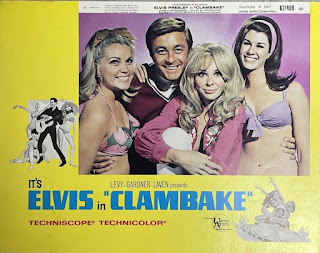
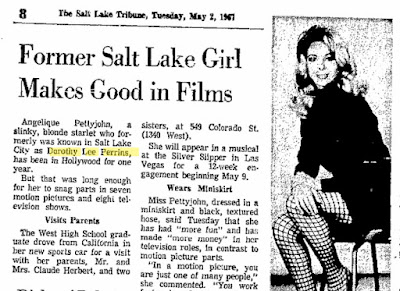
In addition, an article published in the May 2, 1967, Salt Lake City Tribune, titled “Former Salt Lake Girl Makes Good in Films,” unmentioned in Dr. Flynn’s book, reveals that she returned home to see her family in Salt Lake after her film career had begun just a year earlier. She had only just finished filming Clambake with Elvis Presley about a week before the article was published. (She appears in a Clambake lobby card above next to actor Bill Bixby on her right.) The article tells us that she had driven her new sports car from California to Salt Lake “for a visit with her parents, Mr. and Mrs. Claude Herbert, and two sisters, at 549 Colorado St. (1340 West).” The 549 Colorado St. address is the same address as listed in the 1950 census, and it is the street address listed in her mother’s 1973 obituary notice as well.
As for the expected “reunion” with her lover Elvis during the making of Clambake, we are told by Dr. Flynn that “Elvis didn’t remember the eighteen-year-old showgirl that he met so many years earlier when they were re-introduced” (p. 74). “Met” is a profoundly misleading choice of euphemism after the reader had been informed in the preceding chapters that she and Elvis not only had a sexual encounter in Las Vegas, but subsequently spent several days together in Hawaii while Elvis was filming Blue Hawaii. While he was making Clambake a mere six years later, we are asked to believe that Elvis has no memory of her whatsoever. If it is not clear by now, the alleged brief "love affair" she had with Elvis Presley is a hoax.
The newspaper article also indicates that, among other roles, she had appeared as the “bad girl” in Tale of the Cock, a film directed by John Derek and David Nelson starring Don Murray and John Derek’s then wife, Linda Evans, released in 1967. Tale of the Cock was re-released in 1969 under the title Childish Things, and so far as I know, the film is available only on VHS under the title Confessions of Tom Harris. I believe Tale of the Cock, filmed in 1966 and released the next year, is the first movie in which Dorothy Perrins appeared billed as “Angelique Pettyjohn.” Interestingly, her character’s name in the film is “Angelique.”
By 1967, Angelique Pettyjohn seems to have begun a career in Las Vegas as well. The newspaper article states that she was to appear “in a musical at the Silver Slipper in Las Vegas for a 12-week engagement beginning May 9.” The “musical” referred to here is, I suspect, Minsky’s Burlesque, a “family burlesque” show which was a popular entertainment at the Silver Slipper for many years. (Incidentally, it was Harold Minsky who introduced the topless showgirl to Las Vegas, at the Dunes Hotel in 1957.) If the “musical” in which she was appearing opened on May 9, a 12-week run would conclude on August 1. At the time of the newspaper article’s publication, she had not yet filmed “The Gamesters of Triskelion,” filmed later that year during the week October 17-24, 1967, airing on television January 5, 1968.
Later that year, in December 1968, filming began on the AIP biker picture Hell’s Belles, in which Angelique Pettyjohn appeared as the female co-star. The movie opened in Los Angeles on April 16, 1969. Although reviews of the movie were mixed, the April 8, 1969, Daily Variety and the April 16, 1969, Los Angeles Times both considered the film to be a superior motorcycle drama, with both reviews praising co-star Angelique Pettyjohn’s performance, one of the rare instances of her performance being singled out for praise. Hell's Belles opened just over a year later in New York, on April 29, 1970, by which time her film career, for the next several years, had essentially come to an end.
To be continued...